Venture debt is in demand globally. In 2024, the worldwide venture debt market expanded 46 percent to a record aggregate deal value of $83.4 billion (see figure 1). The market for venture debt—loans to venture-backed start-ups—has seen a compound annual growth rate (CAGR) of 14 percent since 2018, according to The Global Venture Debt Report 2025, which covers Europe, India, the Gulf Cooperation Council (GCC), and Southeast Asia and was developed by Stride Ventures in collaboration with Kearney.1

Now equivalent to 20 to 30 percent of total venture capital (VC) funding in the United States and Europe, venture debt has emerged as a strategic financing tool that complements VC, private equity, and other asset classes by offering non-dilutive capital, allowing start-ups to leverage this asset class for a wide range of growth initiatives. A hallmark of venture debt is its adaptability, tailoring deal structures to align with regional market maturity and regulatory frameworks.
The growth in venture debt reflects a broader shift in investment patterns. In a challenging exit environment, VCs are less able to return capital to their investors, making it harder to raise new funds. As a result, they are keeping their powder dry and doing fewer deals, prompting more exploration of alternative financing options, such as venture debt. “VCs have slowed down the rate they are deploying capital, so venture debt is attractive as start-ups need bridge funding,” notes Kai Loon Tee of Mizuho Financial Group.
As venture debt investors tend to prioritize financial stability and cash flow, founders say there is less pressure to achieve hyper-growth than with traditional equity investments. Instead, there is a greater emphasis on profitability through sustainable growth.
Providing the liquidity that start-ups need to scale
Growth financing and working capital are the top global use cases for venture debt, as start-ups use the funds to support expansion and operational efficiency. In developed markets in particular, venture debt is often used to support asset-backed financing, catering predominantly to late-stage companies with larger deal sizes. In the United States, for example, CoreWeave tapped into venture debt to provide essential liquidity for scaling infrastructure-intensive Al and cloud computing ventures.
Fintech and software-as-a-service (SaaS) start-ups, which tend to have more predictable revenue streams, accounted for more than 50 percent of all venture debt deals globally in 2024. Whereas SaaS is the leading sector for venture debt in the United States and European Union, fintech is number one in India, Southeast Asia, and the GCC (see figure 2). Fintechs’ leverage toward onward lending models makes these businesses particularly attractive for venture debt. In the buy-now, pay-later market, for example, Tabby and Tamara have secured venture debt deals of $700 million and $400 million respectively.
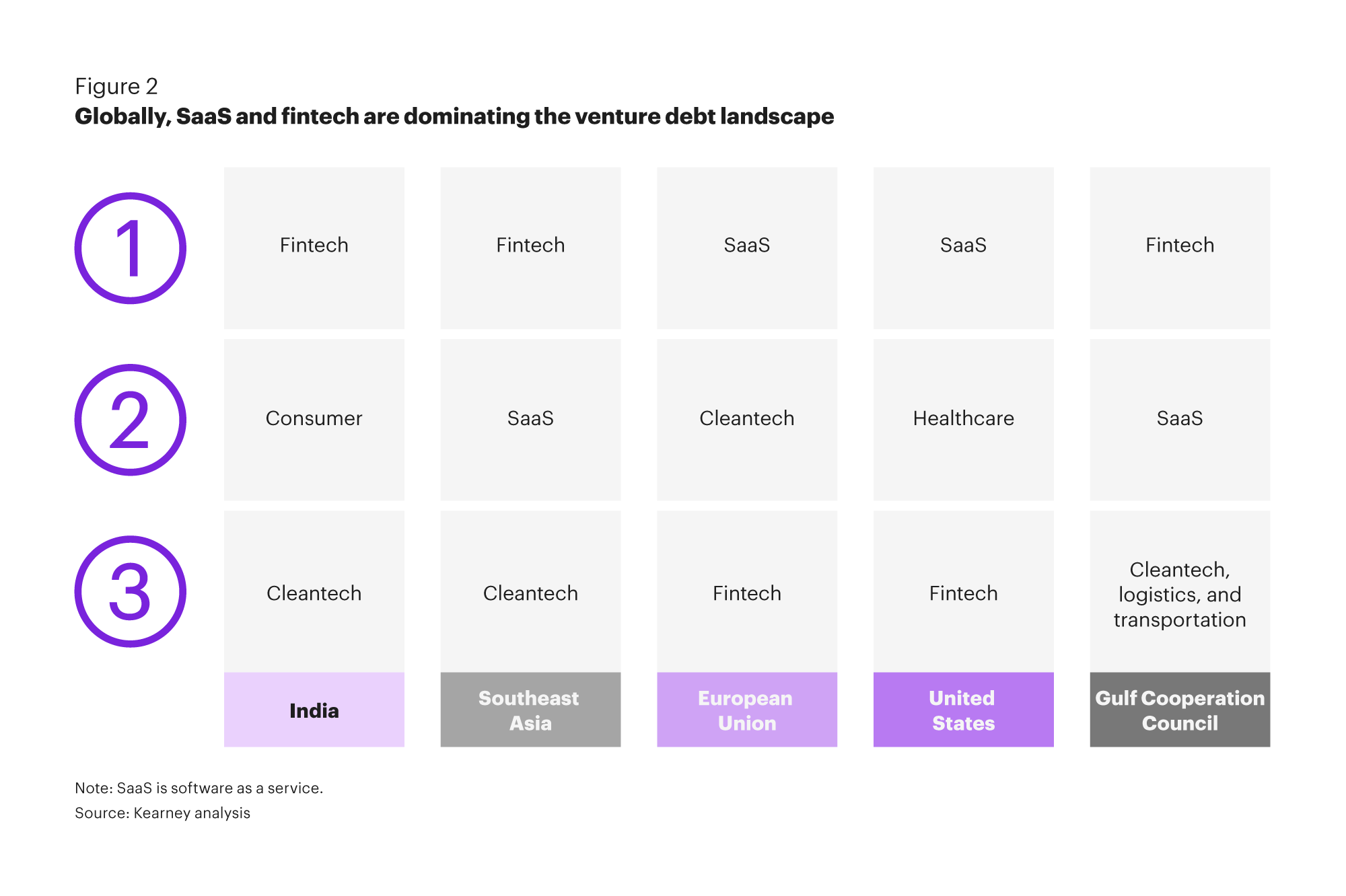
However, the report also found that the consumer and logistics sectors are poised for strong growth. “Consumer start-ups, once seen as a favorite for venture capital investors, are now turning to venture debt (especially in Southeast Asia), as they can achieve profitability quicker than software businesses in most cases,” says Fady Abdel-Nour of Antler Elevate.
Growth patterns vary around the world
The United States continues to lead the venture debt market globally with an aggregate deal value of $49 billion in 2024, but Europe is growing faster (CAGR 21 percent versus 10 percent between 2018 and 2024), fueled in part by strong regulatory support and government incentives. In Europe, aggregate deal value rose to almost $20 billion in 2024 driven by late-stage lending. The UK remains the dominant market in Europe, accounting for about 18 percent of venture debt deals in the region.
However, the European market may be slowing down: 45 percent of the survey respondents in Europe expect moderate market growth in 2025 (3 to 10 percent), with a constrained exit market tempering growth expectations. Some founders believe Europe’s lenders need to develop a better understanding of modern start-ups. “The venture debt market is behind the times,” says Somayeh Taheri of UrbanChain. “They do not understand new-age companies, and the approach to financing is not practical. Most venture debt funds have a bank-like approach, and the offerings are not tailored to suit our requirements.”
In Southeast Asia (CAGR 2018–2024: 75 percent), India (58 percent), and the GCC (54 percent), the venture debt sector is growing very fast, albeit from a much smaller base. In these markets, where the start-up ecosystem is rapidly expanding, venture debt primarily caters to early to growth-stage companies. With a growing share of pre-IPO deals, venture debt offers capital secured by assets and warrant participation to balance risk and return.
In India, which has the world’s third-largest start-up ecosystem, favorable policies, such as the Small Industries Development Bank of India Fund of Funds and GIFT City, are attracting global capital and institutional players. Bengaluru, accounting for 40 percent of deal value, has solidified its position as India’s venture debt hub, followed by Delhi National Capital Region and Mumbai.
The venture debt market could expand further still
In India, 39 percent of the survey respondents are expecting significant (more than 10 percent) market growth in 2025. Even so, venture debt deal value in India is just 10 percent of the country’s VC market, indicating significant growth potential.
Also underpenetrated, Southeast Asia’s venture debt market is set to grow significantly, driven by increasing foreign investment and digital adoption. Demand is surging in the region, particularly in the fintech, SaaS, and consumer sectors in Singapore and Indonesia.
Globally, limited partners are planning to allocate more capital to venture debt over the next two years. About 35 percent of respondents say they plan to increase their venture debt allocations fivefold in the next two years.
Such growth plans underscore how the expanding venture debt ecosystem is reshaping start-up financing globally. For founders looking for tailored solutions to fund innovation and scale their businesses, venture debt is fast becoming a preferred option.
“Europe’s venture debt and growth lending market is scaling rapidly—driven by increasing institutional participation, a maturing start-up ecosystem, and rising demand for non-dilutive capital,” Ravneet Mann, UK partner at Stride Ventures summarizes. “The UK remains a key anchor, underpinned by financial depth, regulatory clarity, and forward-looking reforms such as the Mansion House agenda. With this report, we aim to decode Europe’s evolving credit landscape and advocate for cross-border harmonization to help founders access capital with greater speed and certainty. Stride Ventures remains committed to building a robust, inclusive credit infrastructure—across Europe and globally—to power the next phase of entrepreneurial growth.”
To find out more, read the full report.